Cabinets swelling in humidity is nearly always a materials problem. Budget cabinets are typically particleboard or MDF covered with a thin melamine, vinyl or paper skin, and once moisture slips past that skin the compressed wood particles inside expand and never fully settle back. Solid hardwood takes on moisture too, but it shrinks back as the air dries.
Along the Gulf Coast the air rarely gives cabinets a break, and a sink base or dishwasher end panel adds liquid water to the mix. Here is what happens inside an engineered panel, why the damage usually starts at an edge, what indoor humidity you should aim for, and how construction choices keep a kitchen flat and tight.
What happens inside particleboard and MDF when it gets damp?
Particleboard is made by breaking wood down into small particles, coating them with adhesive and pressing the mat flat under heat. According to the USDA Forest Products Laboratory's Wood Handbook, most particleboard for interior use is bonded with urea-formaldehyde resin, and wax is added only to improve short-term moisture resistance. MDF follows a similar recipe with finer wood fibers.
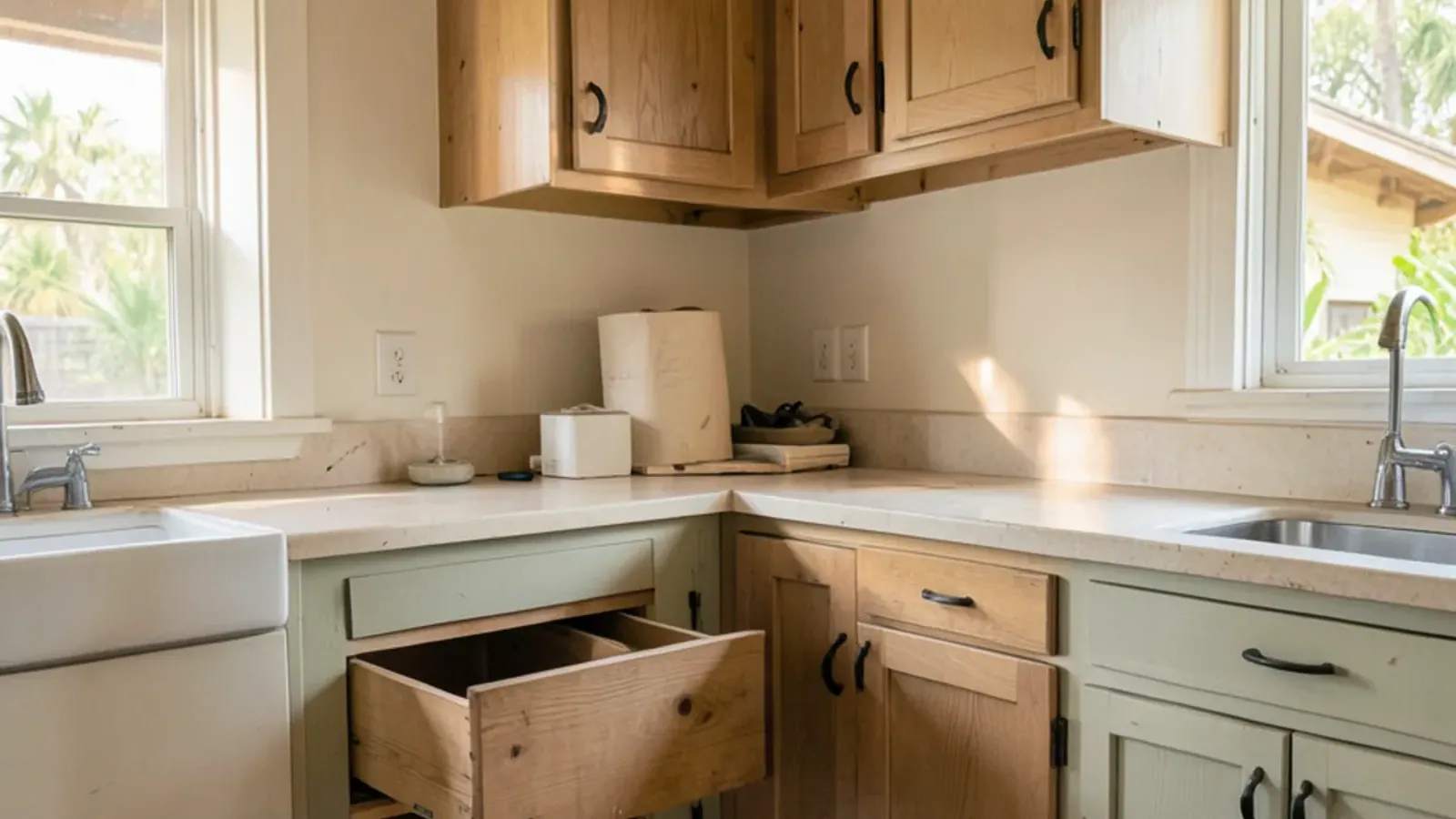
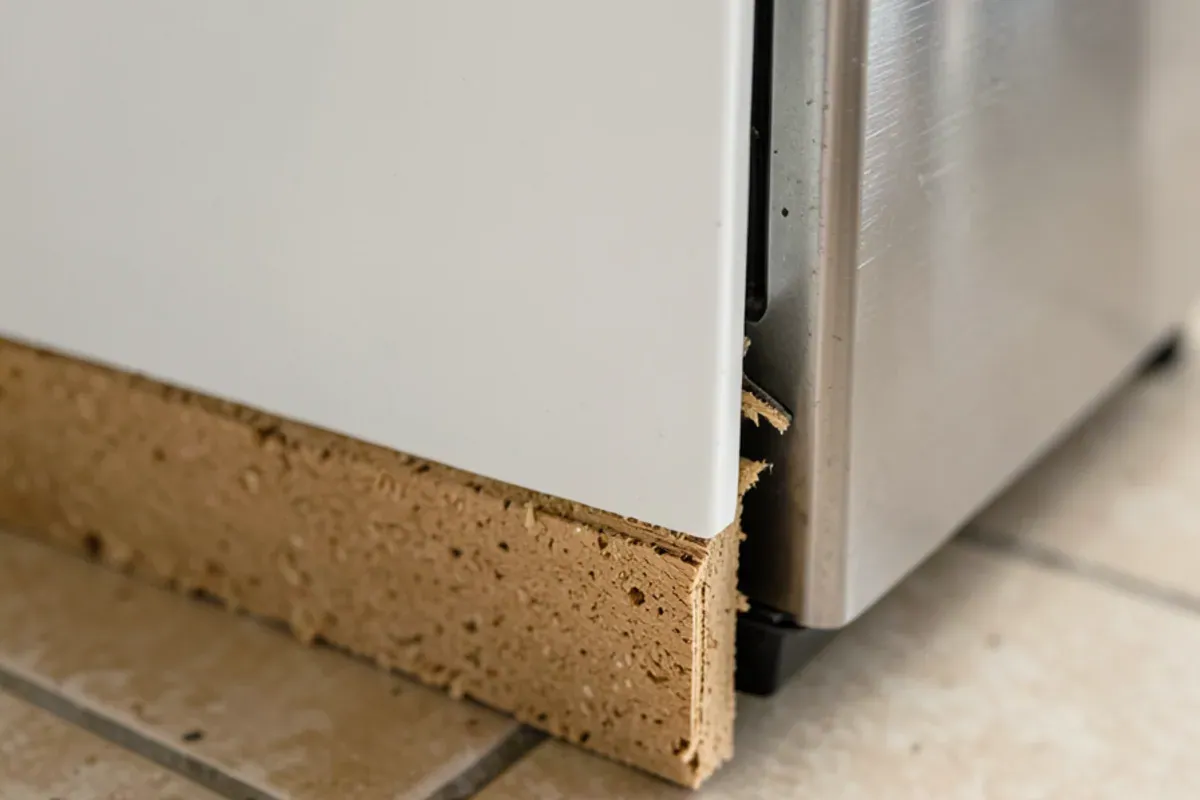
The same handbook contrasts plywood, which undergoes minimal irreversible thickness swelling when wetted, with most panels made from particles, which do not share that advantage. In plain terms: when the particles absorb water they push apart, some of the resin bonds break, and the panel stays thicker and weaker even after it dries. Typical signs in a kitchen include:
- Bottom edges of sink-base sides that look puffed or feel soft
- Hinge screws that spin in their holes or pull out with the hinge plate
- Bubbles or lifting seams in the laminate skin near the dishwasher
- Shelves that bow in the middle after a few humid summers
- Toe kicks that crumble when mopped
Why does cabinet swelling in humidity start at the edges?
The faces of an engineered panel are sealed by the decorative skin. The cut edges are not, so manufacturers glue on a thin strip called edge banding. Banding hides the raw core, but it is only as good as its glue line. Heat from a dishwasher, steam from a kettle and splashes at the sink soften that glue over time, and once a corner lifts, water wicks straight into the most absorbent part of the board.
Drilled holes are another entry point. Every shelf-pin hole, hinge bore and screw hole exposes raw core that nobody sealed, which is why hinges are often the first thing to loosen in a humid kitchen.
In most kitchens the failures show up in the same handful of places, so these are the edges worth checking every few months:
- The end panel and countertop overhang beside the dishwasher, where a puff of steam escapes every time the door opens mid-cycle
- The base cabinet under a coffee maker, kettle or rice cooker that vents steam against the upper doors
- The bottom rail and floor of the sink base, which see drips from wet hands and sponges as well as hidden leaks
- Toe kicks along the floor, which take a splash of mop water every week
- The panel next to the refrigerator, where an icemaker supply line can seep unnoticed
How humid is too humid indoors?
The EPA advises keeping indoor relative humidity below 60 percent, and ideally between 30 and 50 percent, mainly to limit mold. That range is also kind to cabinetry. Running central air conditioning steadily, using bath and range-hood fans, and fixing slow plumbing leaks quickly keep most Gulf Coast homes inside it.
Wood itself settles at a moisture content set by the surrounding air. The Wood Handbook recommends an average moisture content of about 8 percent for interior woodwork across most of the United States, but about 11 percent in damp, warm coastal areas, with individual pieces ranging from 8 to 13 percent. Its outdoor equilibrium data for Miami sit between roughly 12 and 14 percent in every month of the year. Cabinets here simply live wetter than cabinets in Phoenix or Denver.
The riskiest stretch is the closed-up summer house. Seasonal homeowners on Siesta Key and along the Venice beaches sometimes switch the air off or set it very high while they are away, and an unconditioned, shuttered kitchen can sit at high humidity for weeks. A plug-in hygrometer on the counter costs little and tells you what your cabinets are living in.
How solid wood handles the same air
Hardwood absorbs and releases moisture as the seasons change, swelling slightly across the grain in August and shrinking a little in a dry January. Good cabinetmaking expects that. Frame-and-panel doors let the center panel float in its groove so it can move without cracking the frame, and joinery such as mortise-and-tenon face frames holds its shape without depending on screws biting into a crumbly core.
Finish helps but does not seal wood off completely. The Wood Handbook is clear that coatings cannot change the moisture content wood eventually reaches; they only slow how fast water moves in and out. It also notes that finishing one face but not the other is a common cause of cupping and warping, because the two sides take on moisture at different rates.
How much does a solid wood door panel actually move?
Less than most people fear, and it is predictable. The Wood Handbook gives a method for moisture contents between 6 and 14 percent: multiply the board’s width by a dimensional change coefficient published for each species, then by the change in moisture content. We ran its coefficients for a 12-inch door panel going from 8 percent, the handbook’s interior average for most of the country, to 11 percent, its average for damp, warm coastal areas.
| Species and cut | Coefficient per 1% moisture | Estimated swelling across 12 in. |
|---|---|---|
| White oak, flatsawn | 0.00376 (tangential) | About 0.14 in. |
| White oak, quartersawn | 0.00194 (radial) | About 0.07 in. |
| Sugar (hard) maple, flatsawn | 0.00353 (tangential) | About 0.13 in. |
| Black walnut, flatsawn | 0.00274 (tangential) | About 0.10 in. |
| Black cherry, flatsawn | 0.00248 (tangential) | About 0.09 in. |
Roughly an eighth of an inch on a flatsawn panel, and about half that when the grain is quartersawn. That is the gap a floating panel needs in its groove, and it explains why a panel glued tight to its frame eventually splits or pushes a joint open. The handbook cautions that real lumber is rarely perfectly flat- or quartersawn, so treat the figures as estimates. The bigger lesson is direction: a hardwood panel that grows in August gives it back in winter, while a swollen particleboard edge keeps its new thickness for good.
It also explains a piece of good shop practice. Lumber kiln-dried for inland markets arrives drier than it will live on the Gulf Coast, so letting boards settle to local conditions before parts are cut keeps more of that movement out of the finished doors.
Can swollen cabinets be fixed, or should they be replaced?
A single swollen panel, such as the floor of a sink base, can often be cut out and replaced while the rest of the cabinet stays. Loose hinges in sound wood can be re-anchored. But swelling that runs up several box sides means the core has lost its strength, and fixing a single box does nothing for the identical boxes on either side of it. Our cabinet repair service handles the first kind of job; the second usually calls for new boxes.
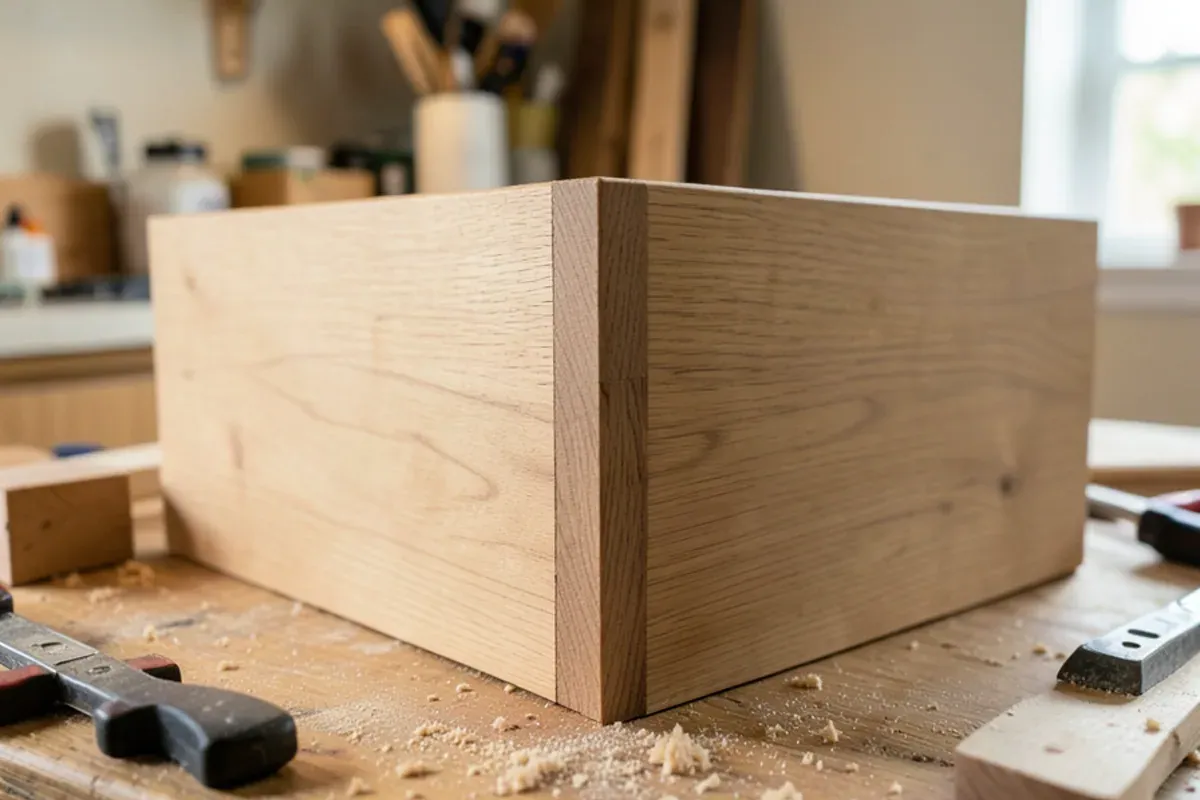
If you are replacing, build with materials that tolerate this climate. Our page on solid wood cabinets explains the species and joinery we use, and the custom cabinetry overview shows how a project moves from drawings and a 3D model to installation.
The bottom line
Swelling is not bad luck or a cleaning mistake; it is what engineered panels do when Gulf Coast moisture reaches their core. Control humidity, keep water off the edges, and when it is time for new cabinets, choose construction that tolerates the climate. To have a cabinet maker look at swollen boxes or talk through a replacement, phone us or use the form on our contact page.
Sources
- USDA Forest Products Laboratory — Wood Handbook (FPL-GTR-282), Chapter 11: Wood-Based Composite Materials
- USDA Forest Products Laboratory — Wood Handbook (FPL-GTR-282), Chapter 13: Drying and Control of Moisture Content and Dimensional Changes
- USDA Forest Products Laboratory — Wood Handbook (FPL-GTR-282), Chapter 16: Finishing Wood
- EPA — A Brief Guide to Mold, Moisture and Your Home