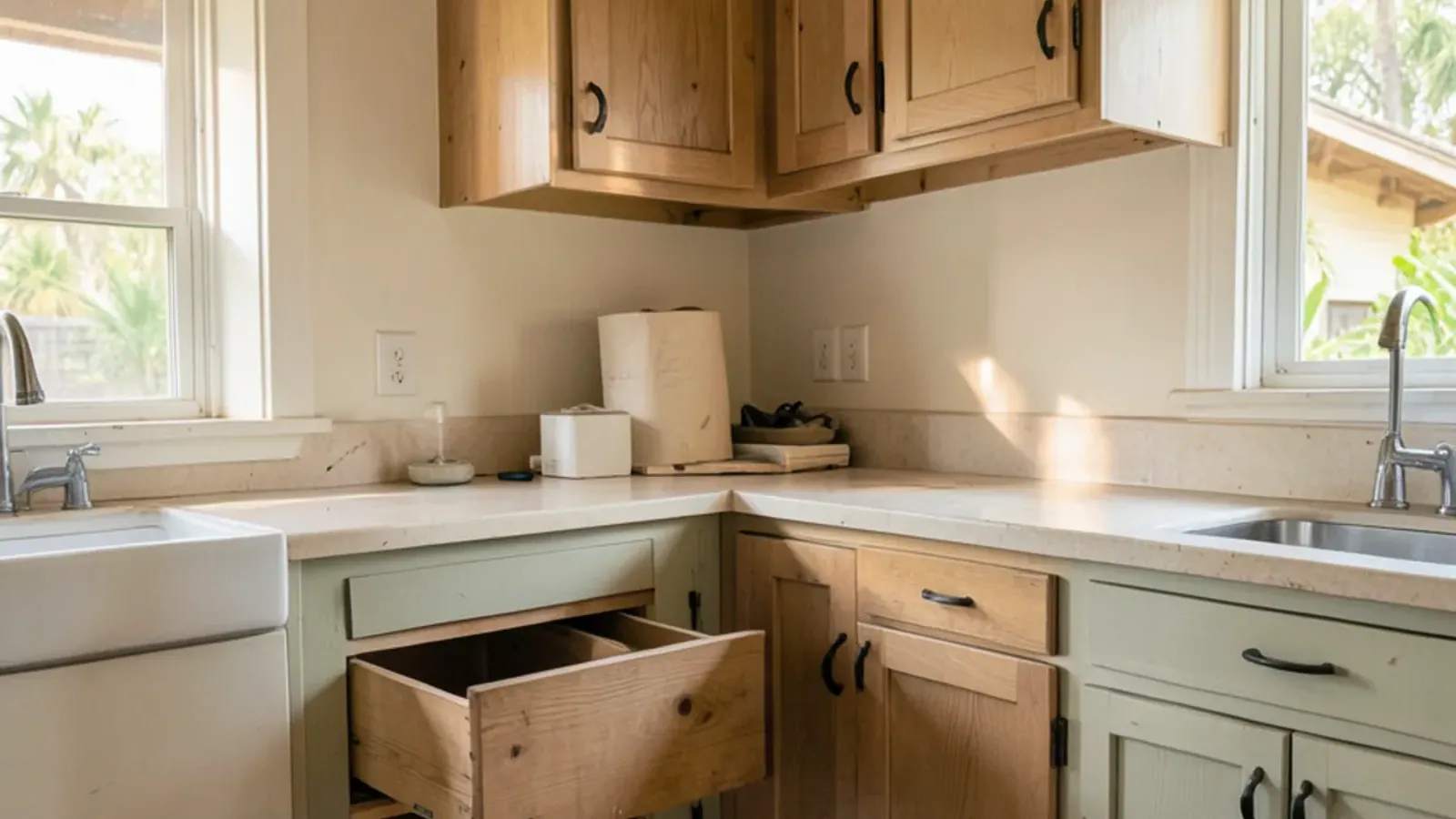
To fix sagging cabinet doors, look at the hinges first. Usually a screw has backed out or stripped its hole, or a concealed hinge has drifted out of adjustment; both are quick to correct. Sticky drawers tend to trace back to a worn slide, a drawer box coming apart at the corners, or wood that has swelled in humid weather.
The trick is knowing which part failed before you start turning screws. Below is a quick way to diagnose the problem, the adjustments most homeowners can make themselves, and the signs that a repair has outgrown a kitchen drawer full of tools.
Start with a diagnosis: which part gave out?
Open and close the door or drawer slowly and watch where it binds, rubs or drops. Then match what you see to the likely cause:
| Symptom | Usual cause | Who fixes it |
|---|---|---|
| Door corner droops and rubs its neighbor | Hinge out of adjustment or loose mounting screw | Homeowner, with a screwdriver |
| Hinge plate pulls away from the cabinet side | Stripped screw holes | Homeowner if solid wood; cabinet maker if the core crumbles |
| Door will not stay closed or springs open | Worn or broken hinge spring | Replace the hinge |
| Drawer drops at the front when pulled out | Bent or worn slide, loose slide screws | Homeowner or cabinet maker |
| Drawer front separates from the box | Failed glue or staples at the corners | Cabinet maker: rebuild the box |
| Drawer drags only in summer | Wood swelling with seasonal humidity | Adjust clearance, wax runners |
One more check before touching a hinge: look down the whole run. If every door on one wall has drifted the same way, the problem is probably not the hardware. A cabinet that was hung out of level, a wall cabinet whose mounting screws missed the studs, or a slab that has settled under the base cabinets will throw all the gaps off together, and no hinge adjustment will hold until the box itself is set straight again.
How do you fix sagging cabinet doors at the hinge?
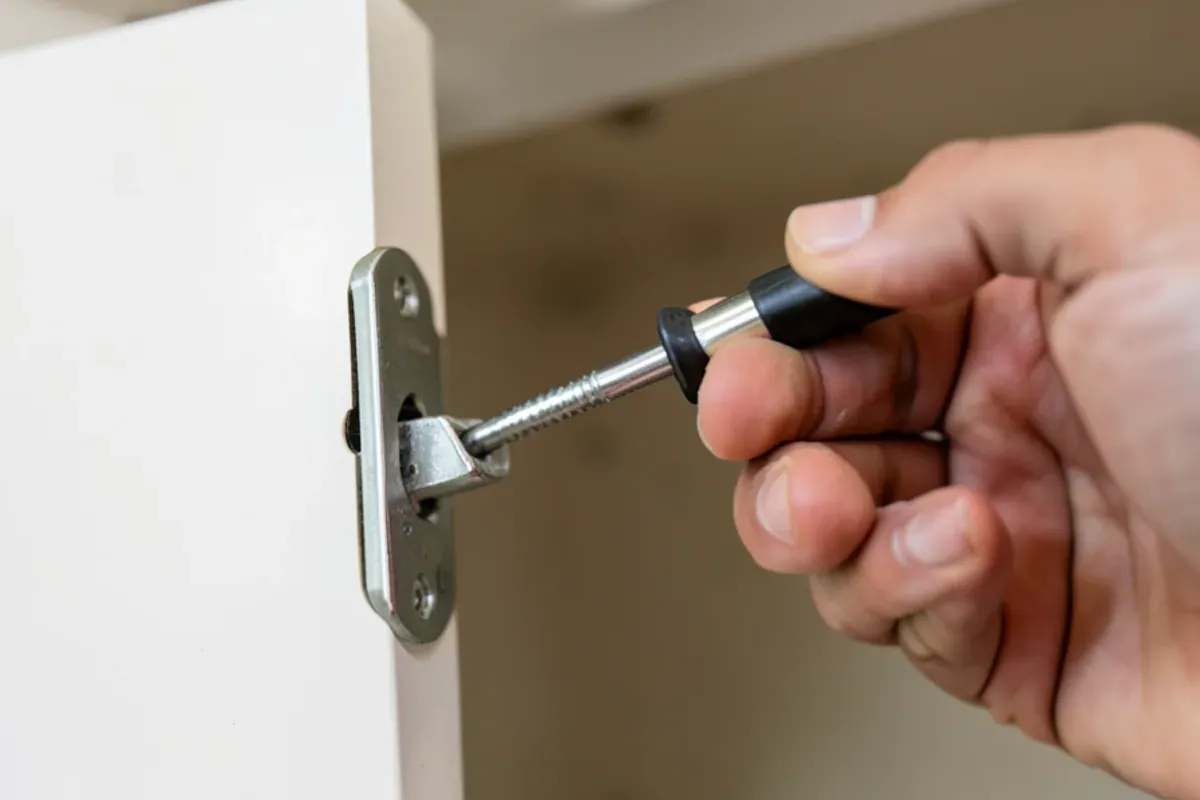
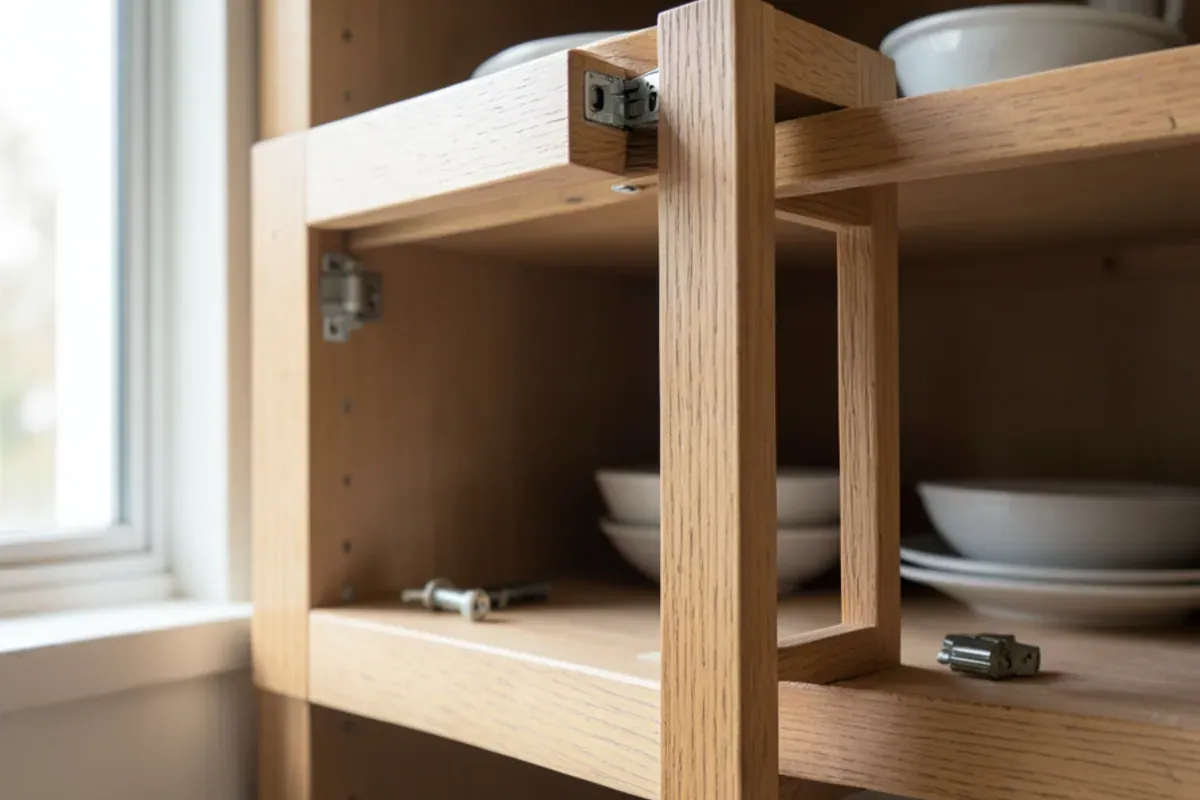
Most modern cabinets use concealed European-style hinges: a cup set into the back of the door and an arm that clips onto a mounting plate inside the cabinet. They are built to be adjusted, usually with three screws.
Check the mounting screws
Tighten the screws that hold the plate to the cabinet side and the cup to the door. A loose plate makes every other adjustment useless.
Side adjustment
The screw closest to the door moves it left or right. Turn it to even the gap between neighboring doors or to lift a drooping outer corner.
Depth adjustment
The screw farther back, or a cam on some hinges, moves the door in and out so it sits flush with the face of the cabinet.
Height adjustment
Slotted mounting plates or a cam on the plate let you raise or lower the door to line it up with the row.
Make small moves
Turn a quarter turn at a time on both hinges, close the door, and check the gaps again before turning more.
Stripped holes and hinges that will not hold
If a screw spins without tightening, the wood around it has been chewed out. In solid hardwood the fix is simple: pull the hinge, glue a snug hardwood plug or a few wood slivers into the hole, let the glue set, trim it flush, and drill a new pilot hole. The repaired spot is often stronger than the original.
Particleboard is another story. Its core breaks into crumbs around a stripped screw, and a bigger screw only buys a few months. Repair inserts can help when the panel is otherwise sound, but if the side panel is soft or swollen near the hinge, the box itself has failed.
Very tall or heavy doors, such as pantry doors or glass uppers, can sag simply because two hinges are not enough. Adding a third hinge spreads the load and is a common fix on full-height doors.
What should you match when replacing a broken hinge?
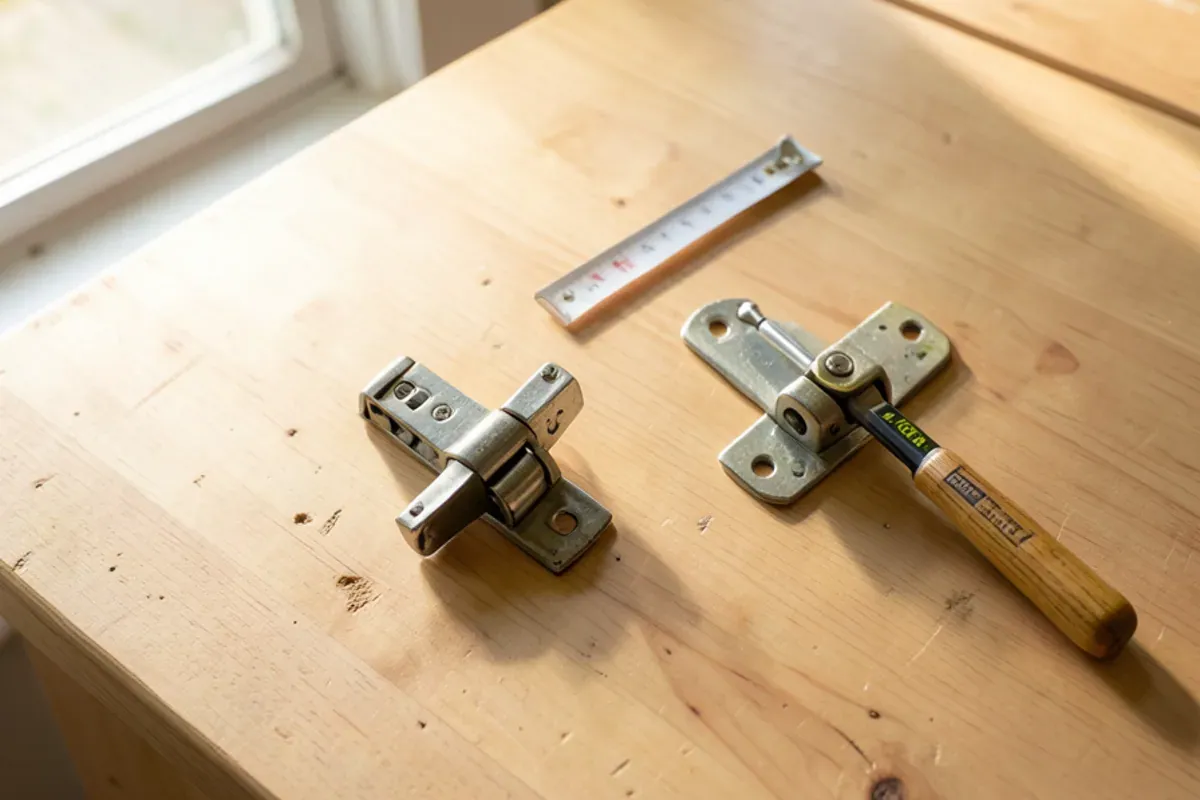
Adjustment cannot save a hinge whose spring has snapped or whose arm has cracked. Replace it, and replace its partner on the same door at the same time so both close with the same force. Take the old hinge with you, or photograph it from the side and the back, and match these details:
- Mounting plate type. Face-frame cabinets need a plate that screws to the frame; frameless boxes use a plate on the inside of the cabinet side. The arm and plate must come from the same hinge system.
- Overlay. Measure how far the closed door covers the cabinet opening. Full-overlay, half-overlay and inset doors each need a different arm crank.
- Opening angle. Hardware catalogs list standard concealed hinges at a 110-degree opening and wide-angle models at 155 degrees, which help a door swing clear of a pull-out or an appliance beside it.
- Cup position. The new cup has to sit in the existing bore in the door, at the same distance from the door edge, or the door will hang off line.
- Closing action. Decide between a self-closing spring, a built-in soft-close damper or a free-swinging hinge, and use the same type on every hinge of that door.
Drive the screws by hand. A cordless drill on a high clutch setting is the fastest way to strip a fresh hole, and a hand screwdriver lets you feel the moment the screw seats.
Why do drawers stick, drag or drop?
Metal ball-bearing slides wear, bend and lose bearings, especially under heavy pots. If one side feels gritty or the drawer drops when extended, replace both slides as a pair and match the length and mounting type. Older drawers that ride on wooden runners just need the runners cleaned and rubbed with paraffin wax.
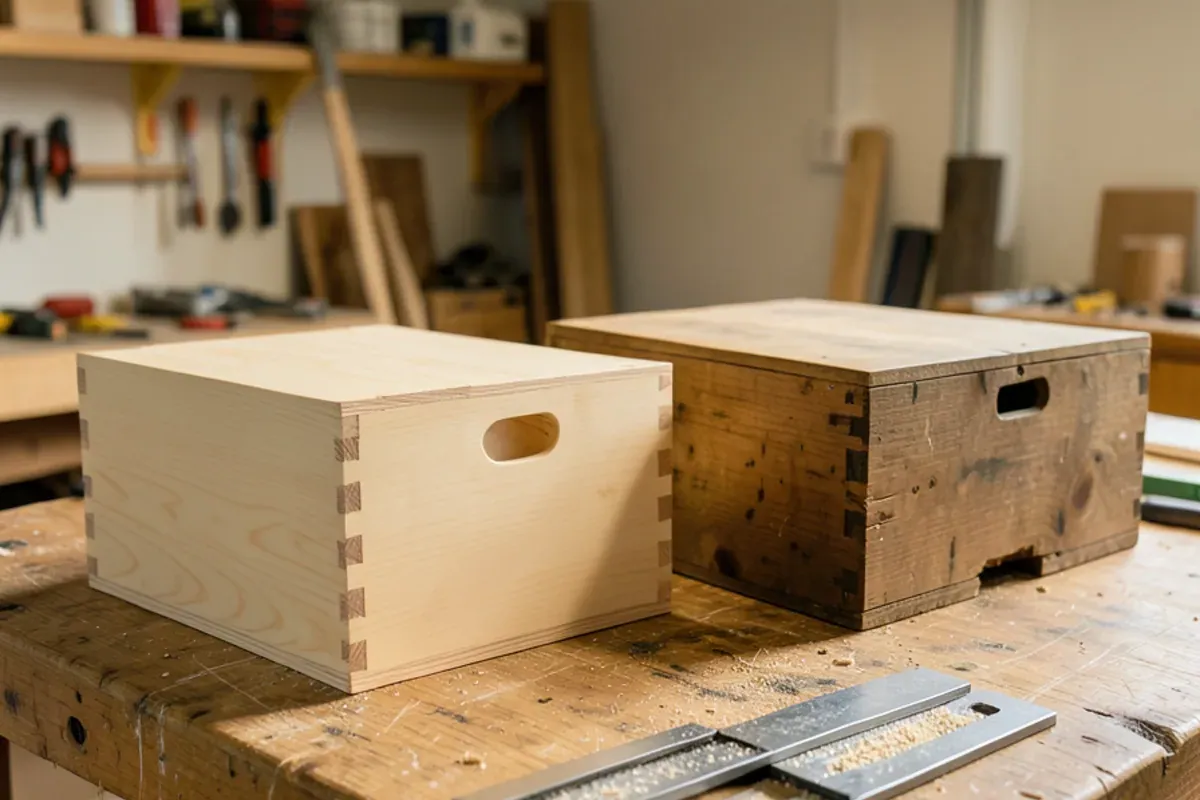
Drawer boxes fail at the corners. Stapled or glued butt joints loosen after years of yanking, the front pulls away, and the bottom drops out of its groove. Dovetailed boxes resist that pull because the joint interlocks mechanically, which is why we use dovetails on every drawer we build.
A drawer that only sticks in late summer is reacting to humidity. The USDA Wood Handbook explains that wood in service is always changing moisture content, and that seasonal changes matter more than daily ones. Easing the tight spot with a plane and resealing the bare wood usually solves it.
When should a cabinet maker take over?
Call for a repair rather than another adjustment when you see any of these:
- A drawer box that has split, lost its bottom or separated from its front
- Face frame joints that have opened so doors no longer line up
- Hinge or slide screws pulling out of swollen, crumbly panels
- A door that is warped or cracked rather than simply misaligned
- Cabinets that need changes for a new dishwasher, range or refrigerator
Our cabinet repair work covers rebuilding drawer boxes to match, replacing worn hinges, upgrading older cabinets to soft-close hardware and modifying boxes for new appliances. Parts are built in our Lewis Ave shop, a short drive from Bradenton and the unincorporated neighborhoods of South Bradenton.
If several boxes are failing at once, the custom cabinetry overview explains what a full replacement involves, and our guide to why cheap cabinets swell in Florida humidity explains the panel failures behind many loose hinges.
The bottom line
A drooping door or a stubborn drawer is rarely a reason to replace a kitchen. Diagnose the failing part, make small adjustments, and repair stripped holes properly. When the box itself is breaking down, that is the moment to bring in a cabinet maker. Phone us or describe the problem on our contact page, ideally with a few photos attached.
Sources
- USDA Forest Products Laboratory — Wood Handbook (FPL-GTR-282), Chapter 13: Drying and Control of Moisture Content and Dimensional Changes
- USDA Forest Products Laboratory — Wood Handbook (FPL-GTR-282), Chapter 11: Wood-Based Composite Materials
- Blum — Catalogue and technical manual 2024–2025, CLIP top BLUMOTION 110° hinge
- Blum — CLIP top 155° hinge, special applications sheet