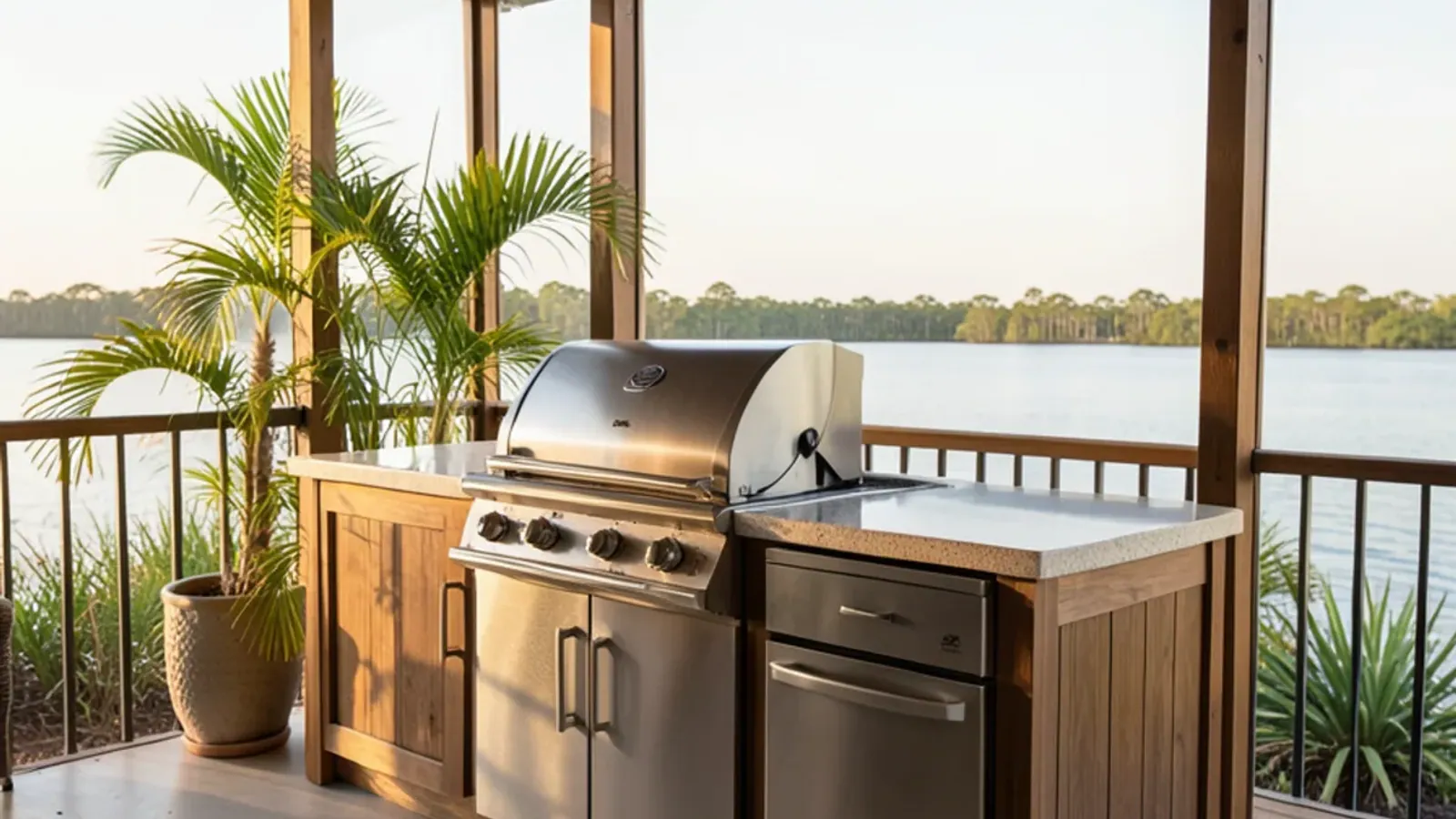
The outdoor kitchen materials that last in Florida salt air are 316 stainless steel for metal parts, UV-stabilized marine-grade HDPE or teak heartwood for cabinet faces, and natural stone or an outdoor-rated surface for the top. Standard 304 stainless, indoor quartz and plain plywood boxes are the weak links on a lanai near the Gulf or bay.
We build outdoor cabinetry in our Sarasota shop, and much of what we know about salt comes from the marine side of our history: yacht interiors, teak swim platforms and brightwork. Below we compare the main options, explain why a covered lanai can be harder on metal than open sky, and list the trade work that goes with any cooking area outdoors.
Why a roof over the grill does not stop corrosion
Most people assume the lanai roof protects the kitchen. For wood and finishes it helps, because it blocks direct UV. For stainless steel it can do the opposite. The International Molybdenum Association notes that sheltered surfaces in hot, humid climates corrode more readily because rain never rinses off the salt that settles on them, and misty salt air dampens metal without cleaning it.
A grill island under a screened cage on Little Sarasota Bay lives in exactly that condition: warm, damp, salty and never washed by rain. That is why we treat fasteners, hinges and drawer slides as seriously as the doors themselves.
IMOA's picture of a typical coastal site makes the contrast plain: surfaces regularly washed by heavy rain, and no sheltered exterior surfaces at all. A screened lanai kitchen fails both tests by design. That puts weight on detailing as well as metal grade. Tight crevices, flat ledges and recessed pulls hold salt and damp longer than smooth, open profiles, so we keep hardware simple and leave door and drawer reveals a hose can actually reach.
Outdoor kitchen materials for Florida, compared
| Material | Salt and moisture | Sun and heat | What to watch |
|---|---|---|---|
| 304 stainless | Adequate inland; can pit or tea-stain near salt water | Unaffected | Rinse often; avoid mixing with 316 hardware |
| 316 stainless | Molybdenum (2–3%) improves pitting resistance in chlorides | Unaffected | Still needs fresh-water rinsing on sheltered lanais |
| Marine-grade HDPE | Will not rot, swell or delaminate | UV-stabilized grades resist sun | High thermal expansion; needs slotted fastener holes |
| Teak heartwood | Very durable; natural oils resist water | Weathers to silver unless oiled | Gluing needs prep; sapwood is not durable |
| Ipe | Very durable | Hard and dense | CITES Appendix II listed since November 2024 |
| Granite top | Needs sealing; recheck with a water-drop test | Handles UV well | Heavy; base must be rigid and level |
| Standard indoor quartz | Non-porous | Resin is UV-sensitive; color can change | Use only outdoor-rated lines in sun |
No single material wins every row. The usual pairing we recommend is a polymer or teak cabinet with 316 hardware and a stone top, then a fresh-water rinse routine after windy weeks. See our outdoor kitchen cabinets page for layouts that combine them.
Is 304 stainless good enough near the bay?
Grade 304 is a fine stainless for an indoor range hood or a lanai miles inland. Grade 316 adds roughly 2 to 3 percent molybdenum, which the Australian Stainless Steel Development Association credits as its main advantage over 304 for pitting and crevice resistance in chloride environments. IMOA describes a typical site where 316 performs well as about 0.12 to 10 miles from a large body of salt water; homes right on the shoreline count as more severe.
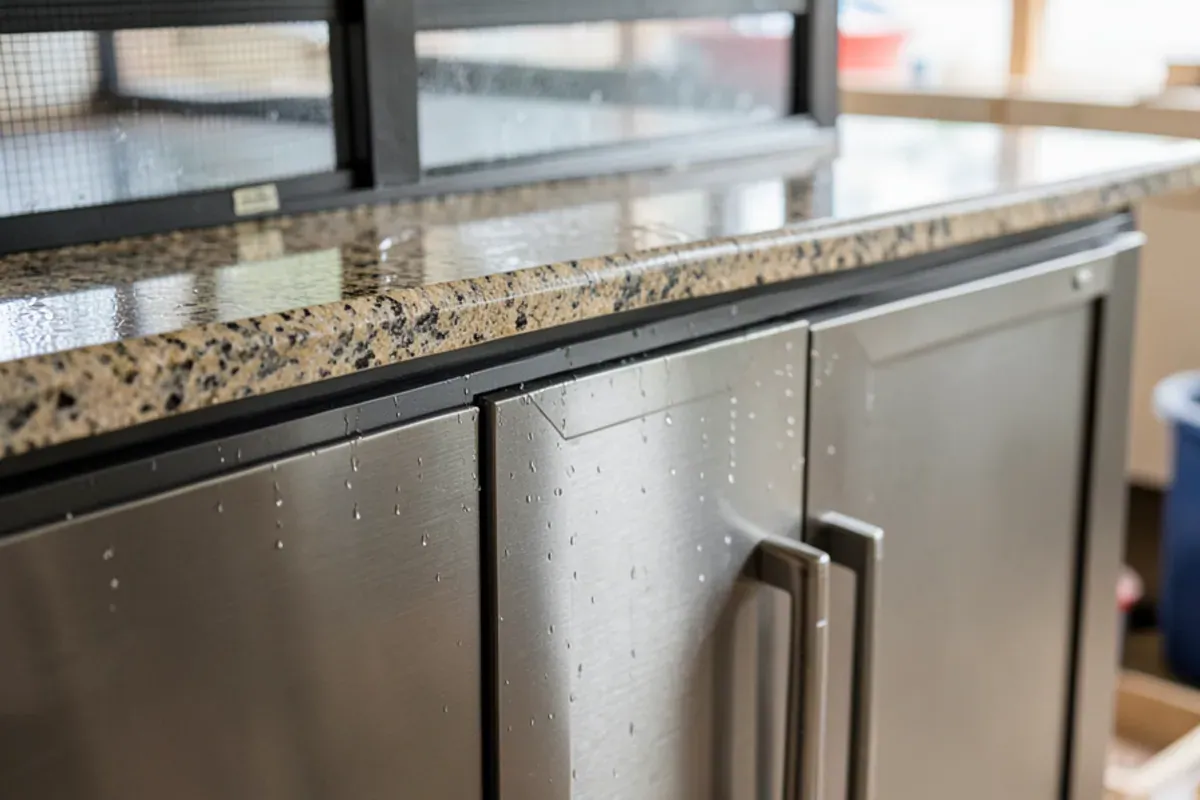
Bayfront lots in Osprey and Vamo sit at the severe end of that range. There, specify 316 for doors, pulls, hinges and every visible screw, and keep 304 and 316 parts from touching so tea staining does not start at the joint. Rinse with fresh water and dry; never use steel wool or chloride bleach on the metal.
When even 316 is not enough
IMOA also cautions that at more severe sites, 316 can still show light, superficial tea staining unless finish and design account for it, and it points to a more resistant grade such as 2205 duplex where conditions are severe and the owner expects a pristine look. Before paying for a premium grade, ask whether the grill, doors and pulls you like are actually offered in it. On many bay-view lanais, 316 parts plus a cleaning habit is the practical answer.
Teak, ipe or marine polymer for cabinet doors?
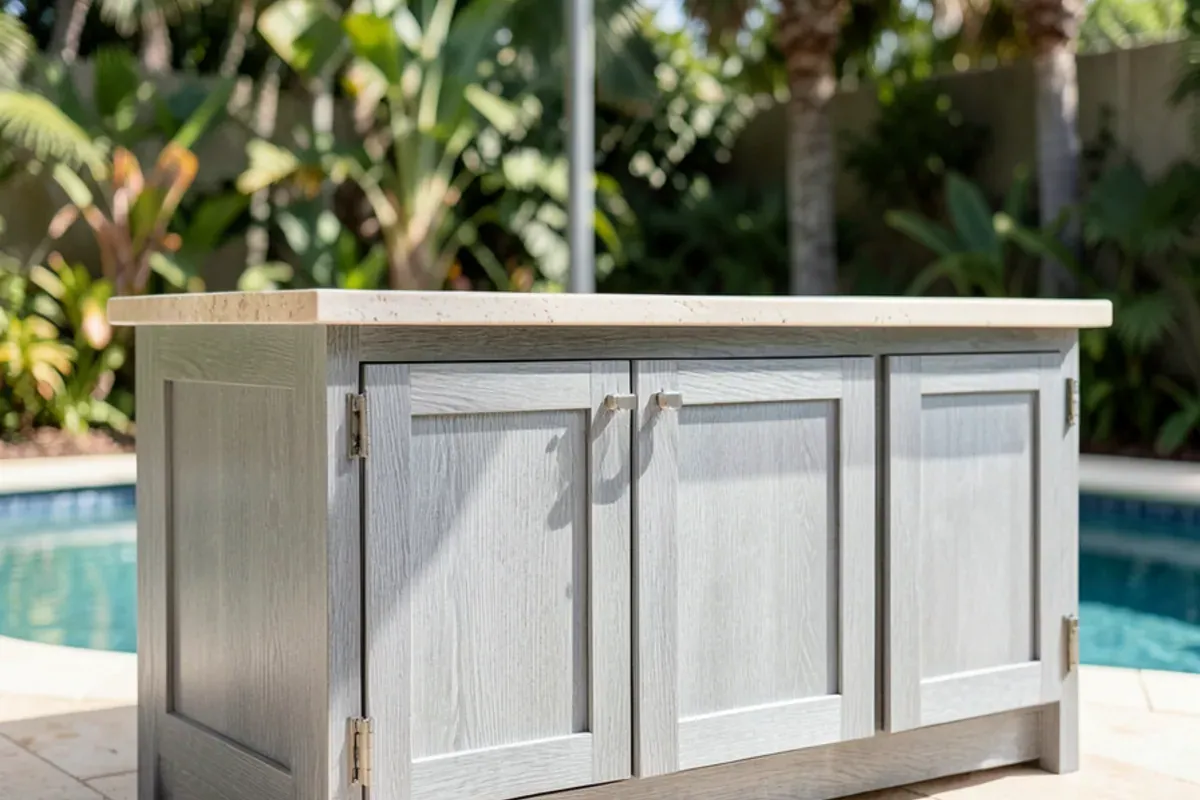
Teak heartwood earns its reputation: The Wood Database rates it very durable and calls it the gold standard for decay resistance. Its silica dulls tools and its oils fight glue, so joints need careful surface prep. Left unoiled it turns silver, which many owners like on a coastal lanai.
Ipe is just as tough, but the genera sold as ipe were added to CITES Appendix II, with the listing taking effect on 25 November 2024. That means any ipe we use must come with legal trade paperwork, so for most outdoor kitchens we steer clients to teak or polymer instead.
Planning a lanai kitchen around trades and drainage
- Gas, power and water belong to licensed trades. A Florida-licensed gas or plumbing contractor runs fuel lines, and a licensed electrician adds outdoor-rated outlets; both pull permits.
- Raise cabinets off the slab on adjustable feet or a plinth so standing water after a storm does not wick into the base.
- Ventilate enclosed bases that house a grill or propane, following the appliance maker's instructions.
- Pick tops after the base is final. Stone needs a rigid, level frame, and the fabricator templates only after the cabinets are fixed in place.
- Plan storm prep now. Know which doors latch, what can be stored inside, and where the gas shut-off is before June.
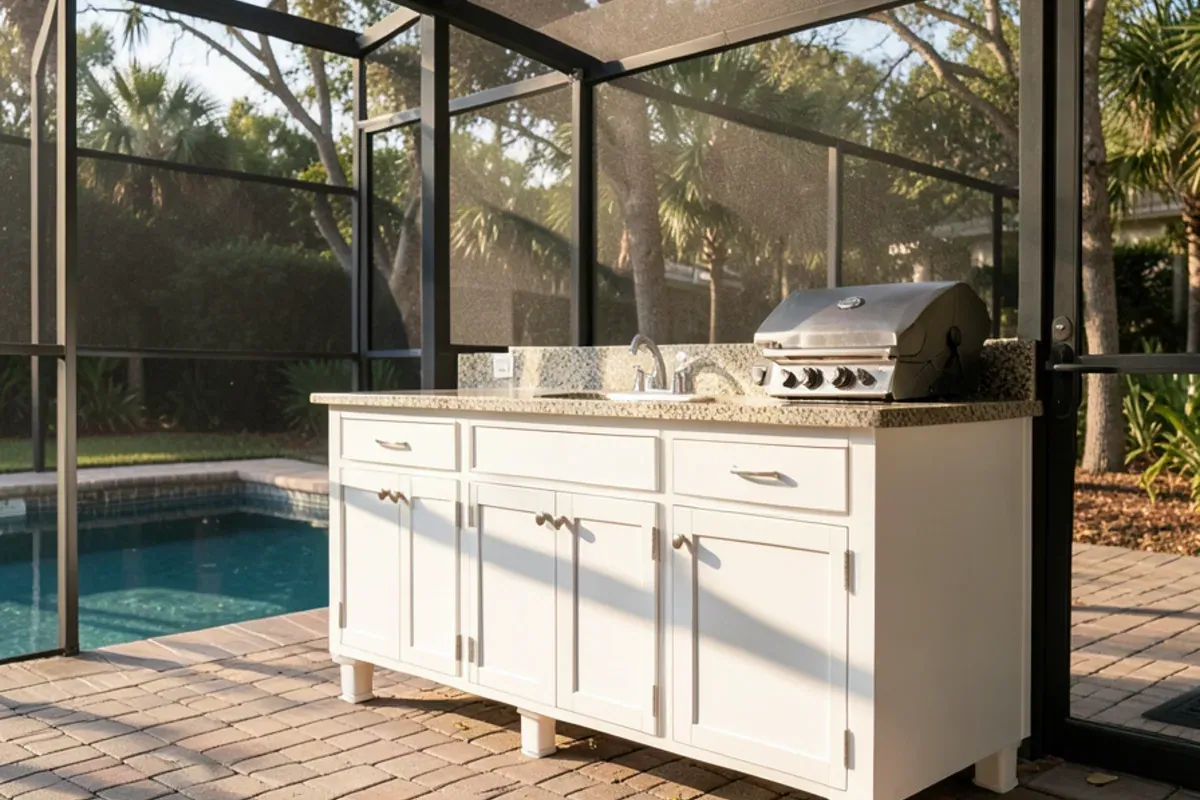
Propane has its own licensing track in Florida. Chapter 527 of the Florida Statutes requires LP gas installers to hold a license from the Florida Department of Agriculture and Consumer Services. Ask your installer to confirm that license before the base cabinet is drawn, since tank location, regulator and shut-off placement all decide where the doors and vents go.
How do you care for an outdoor kitchen near salt water?
Material choice buys time; care decides how the kitchen looks after a few summers on the bay. A short routine covers most of it, and none of it needs special tools.
- Rinse and dry the metal with fresh water on a regular schedule and after any onshore blow, then wipe it dry so drops do not leave salt rings.
- Catch tea staining early with a mild cleaner made for stainless, wiping along the polish lines. Light brown spots lift far more easily in the first week than after a season.
- Decide on teak once. Oil it on a schedule to hold the honey color, or let it weather to silver and simply wash it. Switching back and forth means sanding.
- Check the stone seal with a few drops of water. If they darken the granite instead of beading, it is time to reseal.
- Work every moving part each season. Run drawers to full extension and doors through their swing, and replace a slide or hinge that has started to bind before it scores the cabinet.
The bottom line
Salt is patient, so the materials you pick on day one decide how an outdoor kitchen looks in year ten. Choose 316 hardware, a cabinet face that cannot rot, and a countertop made for sun, then keep a hose handy. To plan a lanai or poolside kitchen with drawings and a 3D model first, call our Lewis Ave shop or use the contact form, then see how it fits with our wider kitchen remodeling in Sarasota.
Sources
- International Molybdenum Association — Corrosiveness of Coastal Environments
- Australian Stainless Steel Development Association — 316: The First Step Up
- The Wood Database — Teak (Tectona grandis)
- The Wood Database — Ipe (Handroanthus spp.)
- CITES — Notification to the Parties No. 2024/129 (Handroanthus, Roseodendron and Tabebuia listings)
- Boedeker Plastics — Seaboard HDPE marine-grade sheet properties
- Caesarstone — Outdoor Collection FAQs (UV sensitivity of standard surfaces)
- Florida Statutes (2025) — Section 527.01, Definitions (LP gas installer categories)
- Florida Statutes (2025) — Chapter 527, Liquefied Petroleum Gas (FDACS licensing)