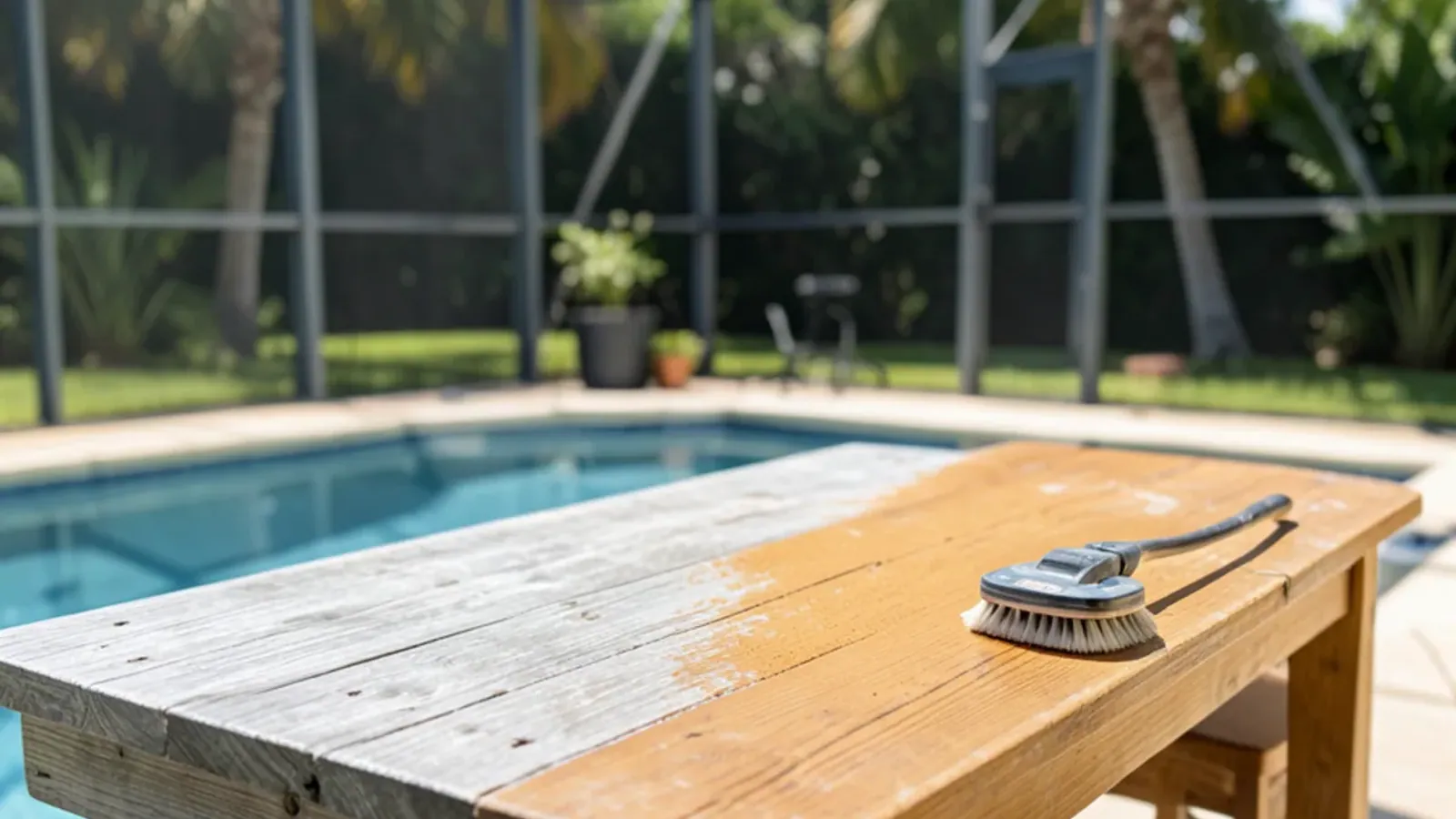
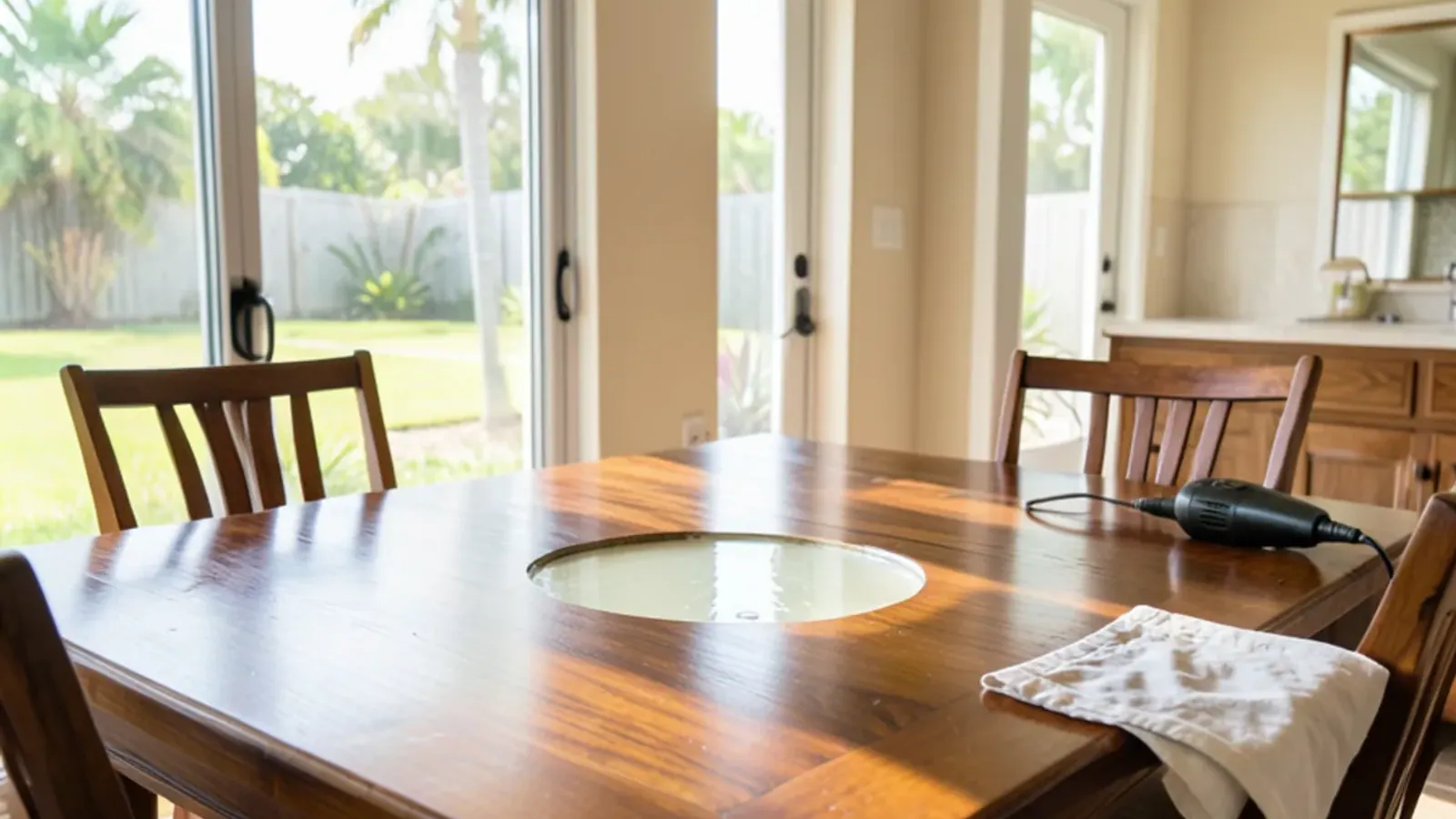
You can usually remove water rings from wood when the mark is white or cloudy, because that haze is moisture trapped in the finish, not in the wood. Gentle, dry heat often coaxes it out in minutes. Dark rings and sun-bleached tops sit deeper and usually belong on a finisher's bench.
A dark gray or black ring is different: moisture slipped past the finish and soaked the fibers below, and fixing it means taking that spot down to bare wood.
Sun fading is a third problem with its own rules, since light changes the color of the wood under the finish. Below we sort the three, explain what you can safely try at home, and describe when a piece is better off on our bench in Sarasota.
White ring or dark stain: which one is on your table?
Look at the mark in raking light from a window. Color and depth tell you almost everything about where the damage sits and how much work it takes.
| What you see | Where the damage is | Typical fix |
|---|---|---|
| Milky white or pale gray ring, often from a cold glass or hot mug | Inside the finish film | Dry heat or a solvent that lets the finish reflow |
| Cloudy patch across a whole area after a spill or steam | Finish has lost clarity over a wide zone | Reflowing or a new top coat over the area |
| Dark gray to black ring or blotch | In the wood, below a breach in the finish | Strip locally, bleach the stain, refinish the surface |
| Pale, washed-out band near a window | Wood color changed by light | Recoloring under a fresh finish, or a full refinish |
| Darker rectangle where a lamp or runner used to sit | Surrounding wood changed color; the covered spot did not | Time in even light, or a refinish and recolor |
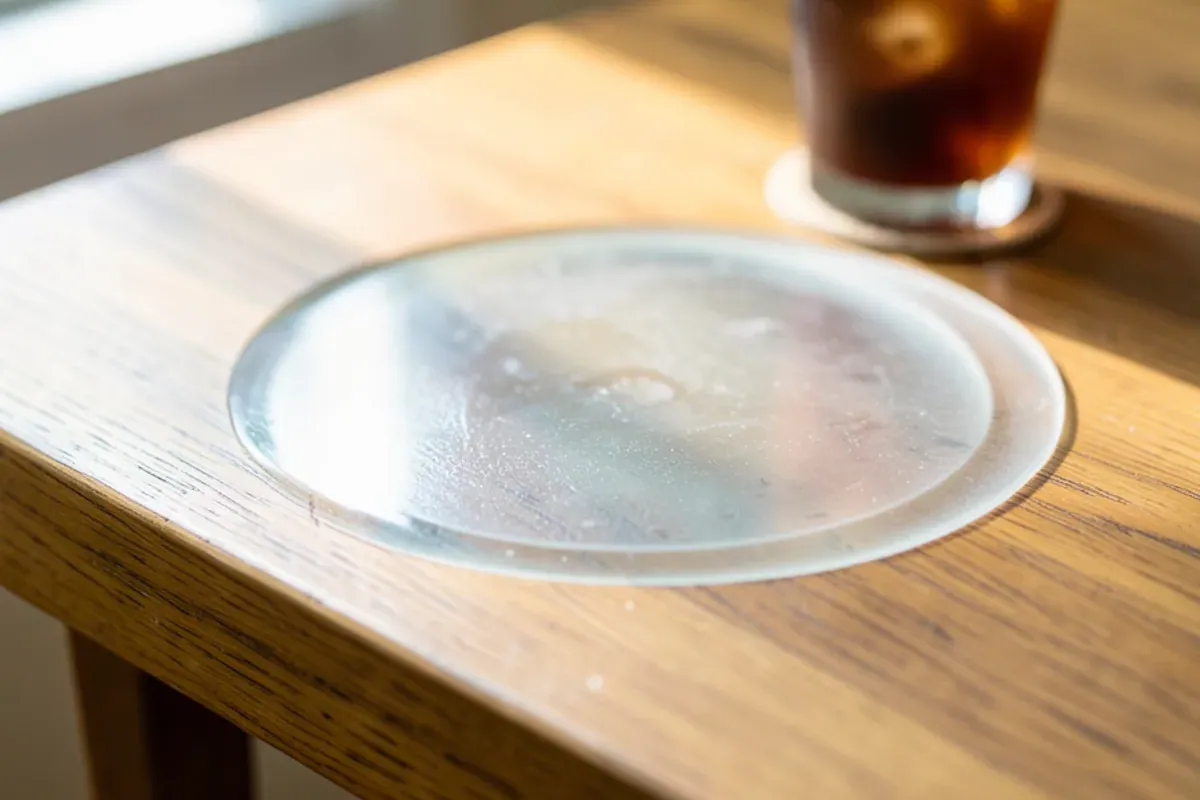
Fine Woodworking describes the white haze as light scattering off tiny voids and trapped moisture inside the coating. Fix the coating and the wood underneath was never the issue.
Lifting a white ring yourself, step by step
Start with the least aggressive move and stop as soon as the haze clears. Test anything on the underside or the back of an apron first.
- Wipe the area dry and let the piece sit overnight in an air-conditioned room. Fresh rings sometimes fade on their own as the finish releases moisture.
- Set a hair dryer to low and keep it moving a few inches above the mark. Watch closely and pause before the surface feels hot to the touch.
- If the ring holds, lay a clean cotton cloth over it and touch it briefly with a dry iron on a low setting, no steam. Lift and check every few seconds.
- Skip the mayonnaise and oil tricks on anything valuable. Oils can soak through worn finish into the wood and darken it, which is far harder to undo.
- If two careful rounds of heat change nothing, the ring is probably deeper than the top layer and needs a finisher.
Shellac and lacquer, common on older pieces, respond well to reflowing because their own solvents can re-soften them. Modern catalyzed finishes and polyurethane do not reflow, so a stubborn ring in those usually means sanding out and recoating the top.
Which finish is on the piece, and why does that change the fix?
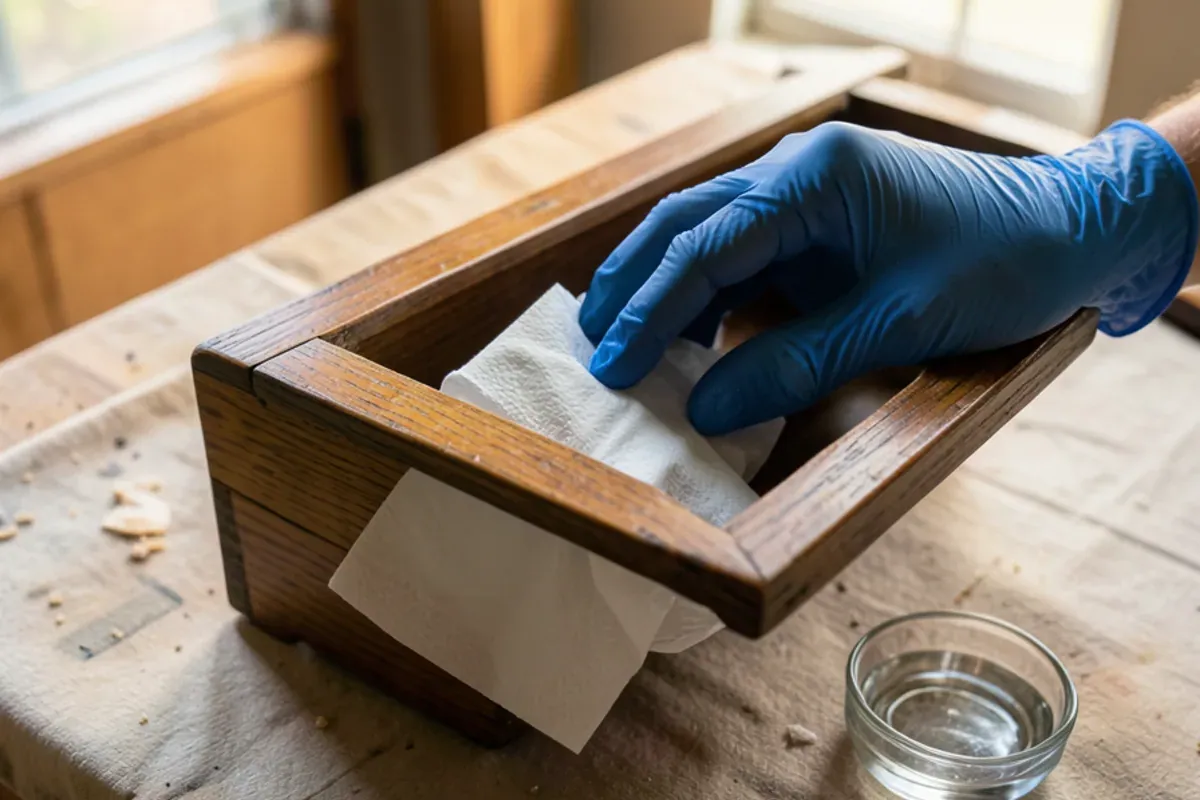
Identify the finish before heat, solvent or sandpaper goes near a ring. Fine Woodworking's guide to identifying finishes for repair sets out a solvent test that a careful owner can run on a hidden spot, such as the inside of a leg or the underside of a drawer front.
Clear off the wax
Rub the test spot with a cotton cloth dampened in mineral spirits, so old polish or paste wax does not hide the result.
Try denatured alcohol
Place a drop, wait a few minutes and rub with a tissue. If the finish softens and comes away on the tissue, it is shellac.
Try lacquer thinner
If alcohol left the surface hard, repeat with lacquer thinner. Turning sticky means lacquer, or a water-based finish on a piece made since the 1990s, when those coatings came into wide use.
Read a no-change result
If neither solvent marks it, you are looking at a reactive finish such as varnish or polyurethane.
The answer shapes the whole repair. A fresh coat of shellac or lacquer melts into the old film, so a ring can be blended out and topped without stripping the piece. A reactive finish will not bond chemically to a new coat; it has to be scuff-sanded so the new layer can grip, or stripped to bare wood if it is badly damaged. That is why the same white ring can be an evening's touch-up on a mid-century lacquered sideboard and a full top refinish on a newer polyurethane table.
Why won't a dark water stain wipe away?
A black ring means the finish failed first, through a crack, a worn edge or a long soak under a plant pot, and water carried dirt and dissolved minerals into the wood. In oak and other tannin-rich species, traces of iron react with the tannin and leave a blue-black mark. No polish reaches it, because it sits below the surface you are rubbing.
The repair is real refinishing work, done on the bench. We strip the finish from the affected area, treat the stain with oxalic acid, which the USDA Forest Products Laboratory's Wood Handbook names as the treatment for iron stains in wood, neutralize and dry it, then rebuild the color and finish so the patch disappears into the rest of the top. Our furniture repair service handles these alongside loose joints and broken parts.
The Forest Products Laboratory's note on iron stain lists plant fertilizers among the everyday sources of iron that turn tannin-rich wood black, which helps explain why saucer rings come out so dark. Its test is straightforward: if a saturated oxalic acid solution clears the mark, iron caused it; if not, and household bleach clears it, the culprit was mildew.
The same note is blunt about the hazards. Oxalic acid can burn skin, eyes and airways, and swallowing a few grams can be fatal. Left on oak too long, it can react with the wood and leave a pink cast, and the surface must be washed thoroughly with fresh, warm water afterward. The stain can return if iron stays behind, so we find the source, such as a rusted caster, before the color goes back on.
Sun fading lives in the wood, not on it
Ultraviolet and visible light change the chemistry of the outer layer of wood. The Wood Handbook explains that light breaks down lignin near the surface, and the color shifts as it does. Cherry darkens toward red-brown, while walnut and many mahoganies lighten and turn honey-colored. A clear finish slows the process but does not stop it.
Gulf Coast light makes this fast. A dresser beside west-facing sliders in a Sarasota or Bradenton living room can show a two-tone top within a few seasons, and the edge of the fade lines up exactly with the window frame. Because the change can run deeper than a light sanding reaches, sanding alone rarely evens it out.
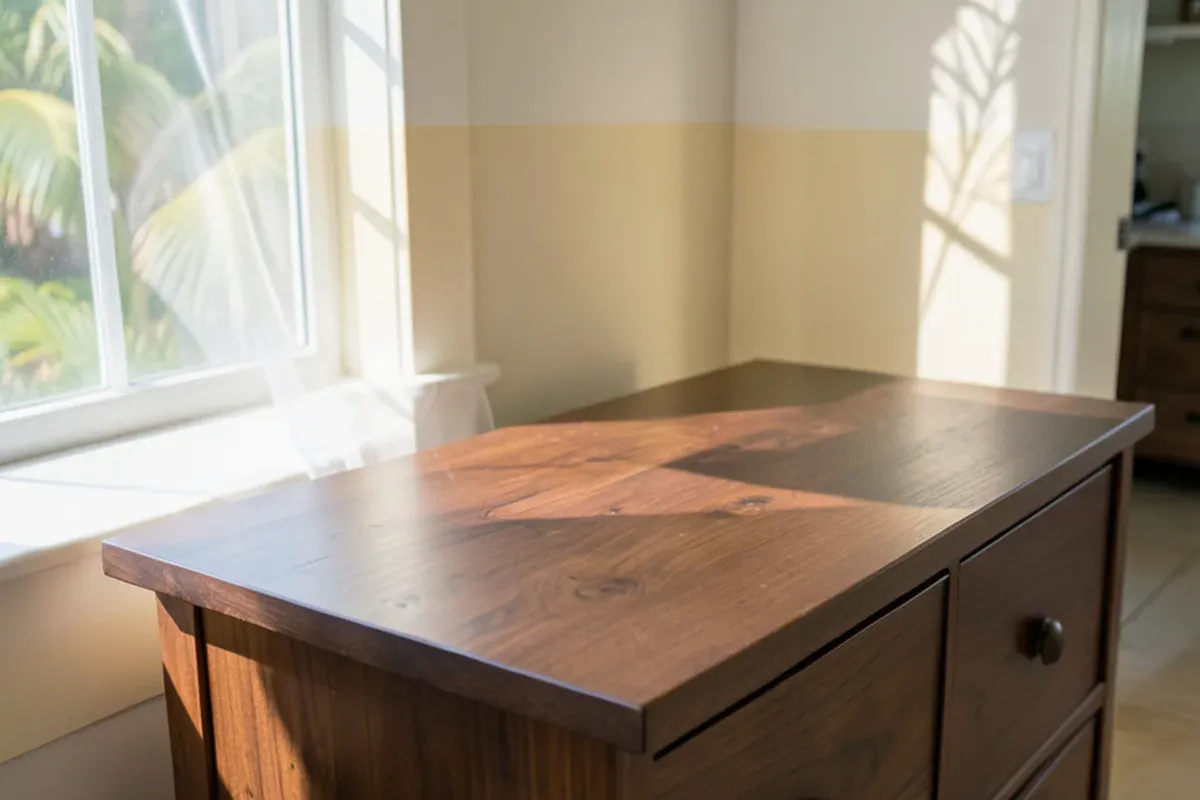
Correcting fading usually means blending color with dyes or tinted toners under a new finish so the pale and dark zones meet. On a heavily bleached top we may strip it, even out the base color, and finish it again from scratch.
Window film helps, but it does not stop the process. The Canadian Conservation Institute's note on ultraviolet filters states that both UV and visible light cause fading, so blocking UV alone will not prevent it, and the UV absorbers in filters break down over time. Pair any film with shade during the afternoon hours when sun lands on the piece.
When is a full refinish the better call?
Spot repair makes sense when the rest of the finish is healthy. Once several of the signs below show up together, a complete furniture refinishing job usually costs less in the long run than chasing individual marks.
- Several rings of different ages scattered across a top
- Finish that feels rough, crazed or sticky beyond the marked spot
- Fading that covers more than half the surface or crosses multiple boards
- Black stains at end grain or joints, where water keeps coming back
- A color you never liked from the start
Pieces from homes in Sarasota and Bradenton come to the Lewis Ave shop by drop-off; ask about pickup and delivery for a heavy table or case piece, which may carry a fee. If a piece could be a valuable antique, have it appraised before anyone strips it.
Marks on an original shellac or lacquer surface are often better handled as antique furniture restoration, where the aim is to clean, reflow and conserve the old finish rather than replace it.
The bottom line
Most water marks are less serious than they look, and the color of the ring tells you which kind you have. Try dry heat on a white ring, leave dark stains and wide fading to a finisher, and keep plants on raised saucers. If you would like us to look at a table or dresser, send a few photos or call the shop to set up a drop-off at Lewis Ave.
Sources
- Fine Woodworking — All Things Pale and Cloudy (2025)
- USDA Forest Products Laboratory — Wood Handbook: Wood as an Engineering Material, FPL-GTR-282 (2021), Chapter 16, Finishing Wood
- National Park Service — Conserve O Gram 7/1, Cleaning Wood Furniture (1993)
- Fine Woodworking — How to Identify Finishes for Repair, Mark Schofield, issue #206 (2009)
- USDA Forest Products Laboratory — Iron Stain on Wood, Mark Knaebe, FinishLine (revised 2013)
- Canadian Conservation Institute — Ultraviolet Filters, CCI Notes 2/1, Tétreault and Anuzet (2015)