The closet systems that cope with Florida humidity share three traits: panels that do not soak up moisture at cut edges, gaps and openings that let conditioned air reach the back wall, and a finish on every face, including the hidden ones. Material matters, but airflow and sealing matter just as much.
Closets sit behind closed doors, often against an outside block wall, with little air moving through them. That is where musty smells, sagging shelves and mildew on leather shoes begin. Here is what we weigh when building closets in our Sarasota shop for homes from the coast to I-75.
Why do Florida closets turn musty?
Air conditioning dries a house by pulling moist air across a cold coil. A closed closet gets almost none of that air. Clothes, towels and shoes add their own moisture, and a closet on an exterior wall can run cooler and damper than the bedroom beside it. Leave that alone through a wet summer and the relative humidity inside the closet can sit well above the rest of the house.
EPA mold guidance puts the target under 60 percent relative humidity, with 30 to 50 percent as the ideal band. A cheap hygrometer left on a closet shelf for a week will tell you whether yours is keeping up. If it reads high even with the door open, the fix starts with the air conditioning or a dehumidifier, not with new shelving.

Which closet systems handle Florida humidity: melamine, plywood or solid wood?
Most off-the-shelf closet systems use melamine: particleboard faced with a thin plastic layer. The faces resist moisture well. The weakness is the core, which can swell wherever a cut edge, a drilled hole or a chipped corner lets humid air in. Plywood and solid wood behave differently, and each has its place.
| Material | Moisture behavior | Strength over long spans | Notes |
|---|---|---|---|
| Melamine-faced particleboard | Faces shed moisture; exposed core swells and crumbles | Sags under folded sweaters or shoes unless kept short | Edge banding must be intact; damaged holes do not hold screws again |
| Hardwood plywood, finished | Moves little once sealed on all faces | Stiff; holds shelf pins and hinge screws well | Takes paint or a clear finish; edges get a solid-wood strip |
| Solid hardwood | Expands and shrinks across the grain with the seasons | Excellent when thick enough | Needs joinery that allows movement; often used for drawer fronts and shelf edges |
| Wire or ventilated metal | Does not absorb water | Fine for light loads | Allows airflow but leaves marks on knits and tips small items |
Composite panels sold in the United States must meet the EPA's TSCA Title VI formaldehyde emission rules, so emissions are regulated either way. The practical difference in a humid house is durability. Our shop does not build boxes from mass-produced particleboard; closets get finished plywood carcasses with solid hardwood edges and dovetailed drawer boxes.
Letting air move through the closet
A closet that breathes stays drier. Most of the moves below cost little when they are planned into the drawings rather than added later.
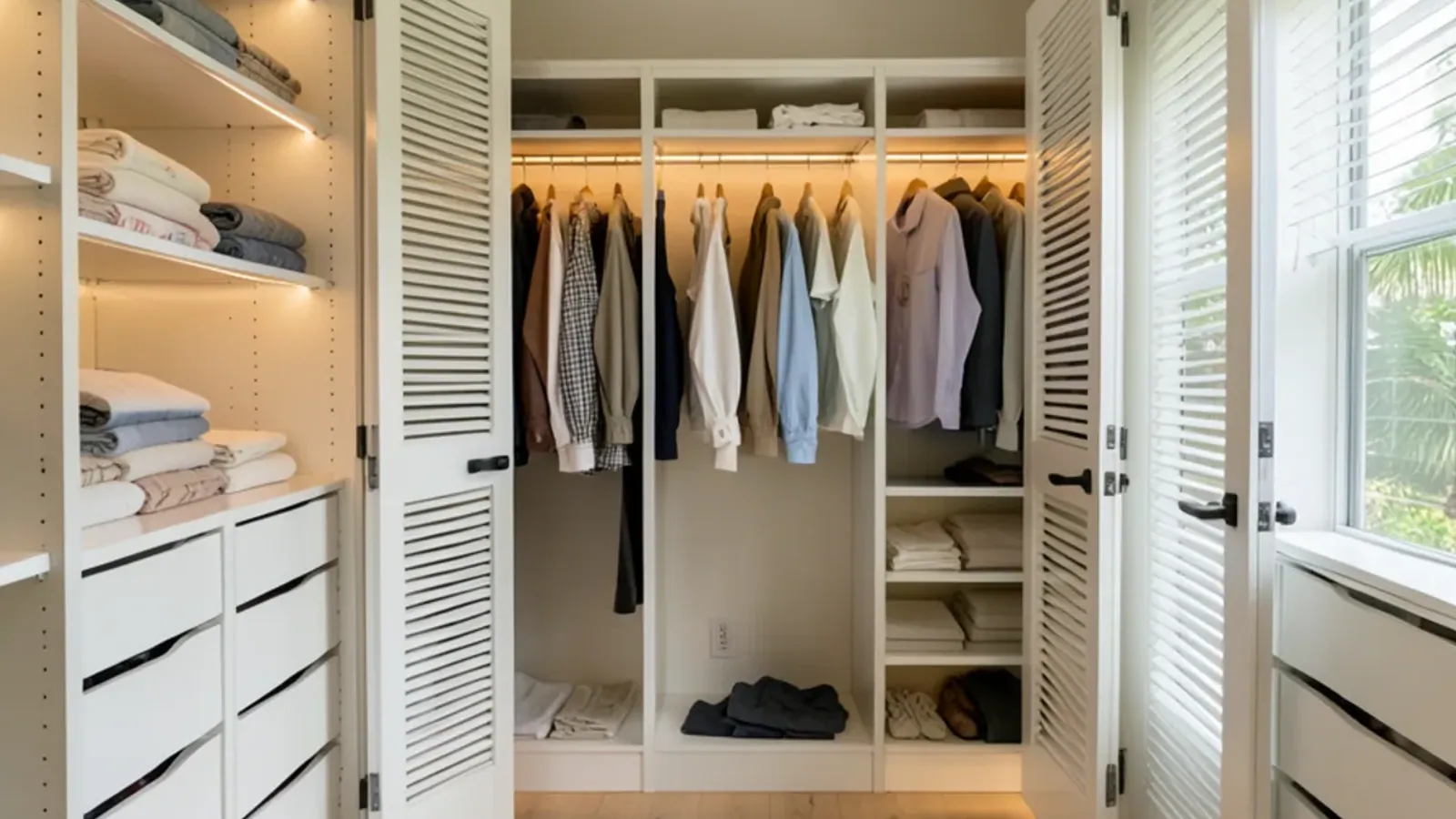
- Hold shelves and panels a small distance off the back wall, especially an exterior block wall, so air can circulate behind them.
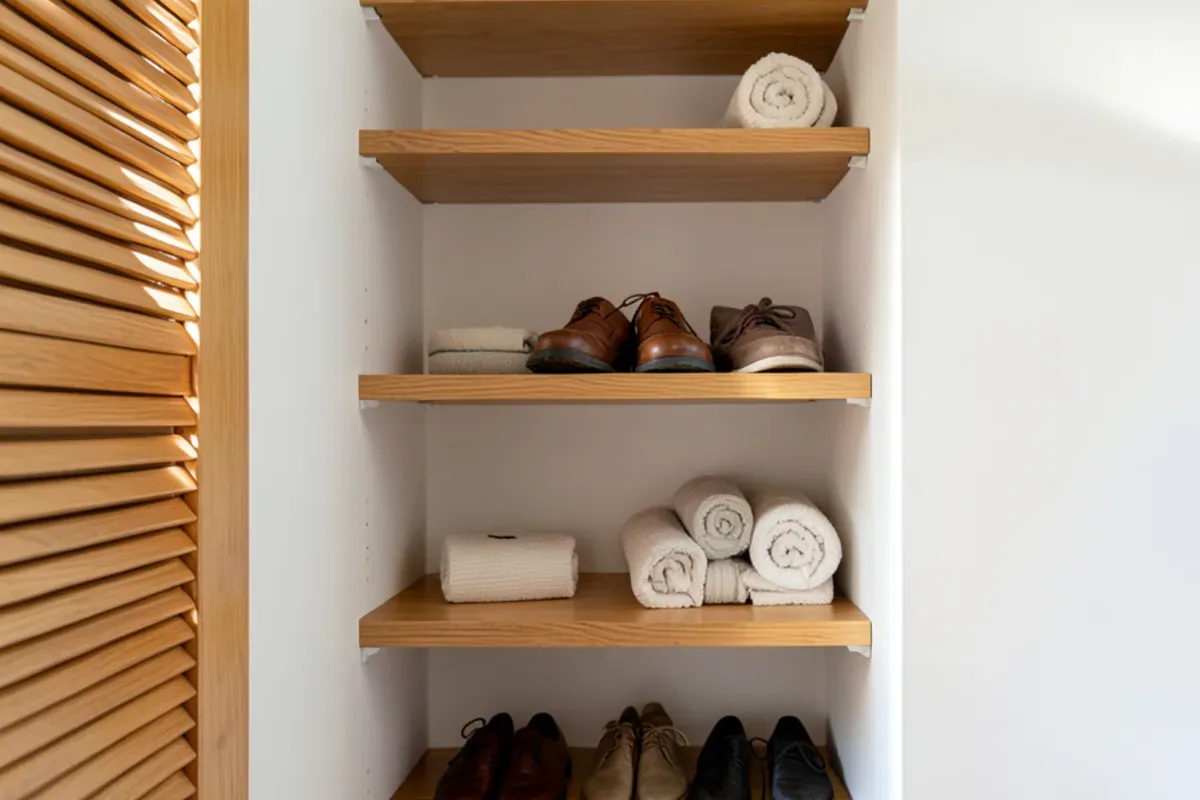
- Use slatted or open-back shelves for shoes and linens rather than solid boxes with backs.
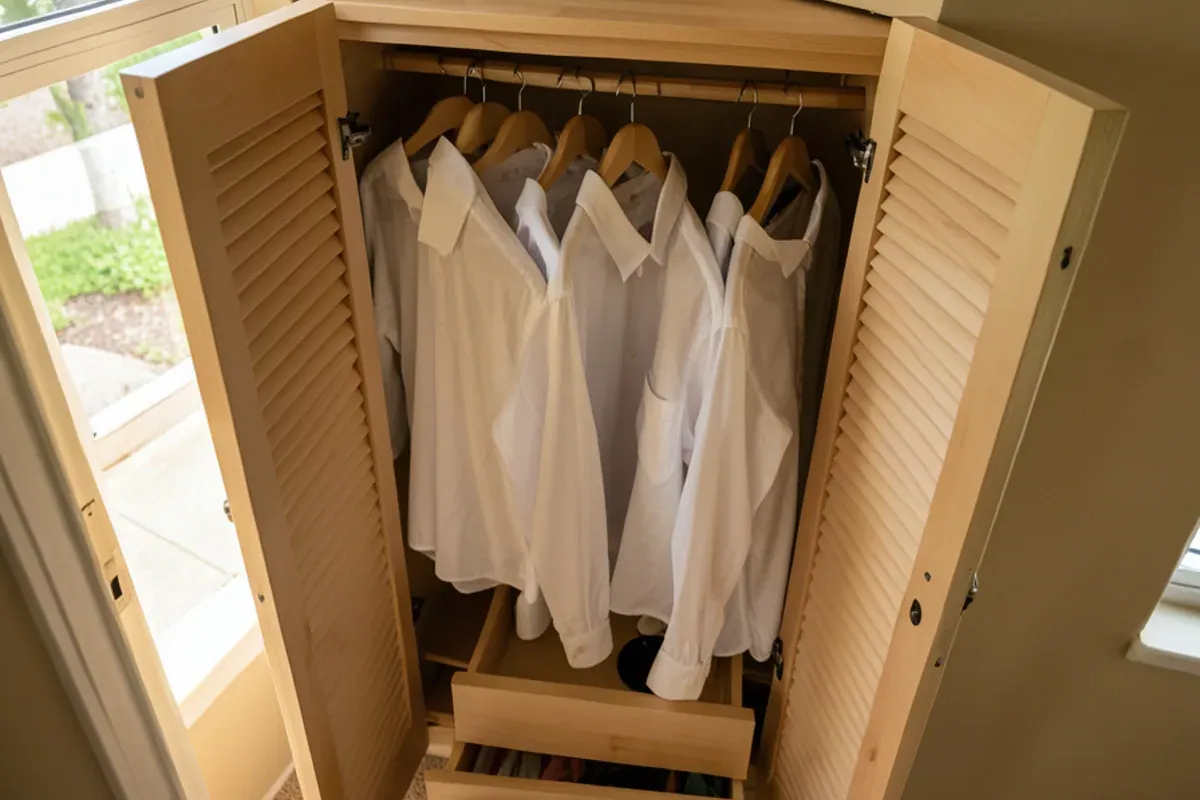
- Choose louvered doors, or undercut solid doors so air from the bedroom can pass beneath them.
- Keep the supply register or return path unobstructed if the closet has one.
- Light the closet with LED strips, which add little heat, and put them on a door switch so they do not stay on.
- Leave a bit of empty rod; packed clothing blocks airflow as surely as a wall.
Which finishes keep closet wood stable?
Every board trades moisture with the surrounding air until the two settle; the Forest Products Laboratory's Wood Handbook names that settling point equilibrium moisture content. A finish slows that exchange. It only works evenly when every face gets the same protection, so a shelf sealed on top and raw underneath will try to cup.
The handbook puts numbers on why Florida is harder on closet wood. For interior woodwork and furniture it recommends an average of about 8 percent moisture content for most of the United States, but 11 percent, with individual pieces anywhere from 8 to 13, in damp, warm coastal areas. Its outdoor table for Miami runs from roughly 12 to 14.5 percent month by month. A closet that the air conditioning barely reaches drifts toward those outdoor figures, and every point of moisture a board gains shows up as width.
Aromatic cedar is a fine lining for drawers or a sweater cabinet, but it is not a cure for damp. Its scent fades over the years and it still needs dry air around it to stay pleasant.
How should a closet be left when the house sits empty all summer?
Seasonal homes are where closet problems show up fastest, because nobody opens the doors for months. LCEC, the electric cooperative serving much of Southwest Florida, notes that mold and mildew can grow nearly anywhere when relative humidity stays at 70 percent or higher, and that many unoccupied homes need some air conditioning every day through the summer. Its guidance lists three approaches: a timer that runs the system two hours a day, a humidistat set to start cooling above 65 percent, or a thermostat held at 83 degrees for short trips only.
Whichever setting your HVAC contractor recommends, the closet still has to share in that drier air. Before leaving for the season:
- Prop closet doors open, or leave louvered doors unblocked by furniture.
- Pull drawers out an inch so air can reach the drawer boxes and their contents.
- Take clothing out of dry-cleaner plastic, which traps moisture against fabric.
- Put shoes, belts and bags away clean and dry, since leather is often the first thing to show mildew in a shut closet.
- Leave a hygrometer on a shelf with a memory function, so the high reading is waiting for you in November.
Layouts for reach-in and walk-in closets
Reach-in closets in established neighborhoods
Many homes built in the 1980s and 1990s in Fruitville came with a single rod and a wire shelf behind bifold doors. Replacing that with double-hang rods on one side, a drawer stack in the middle and adjustable shelves on the other can nearly double usable storage without changing the opening.
Walk-ins in newer builds
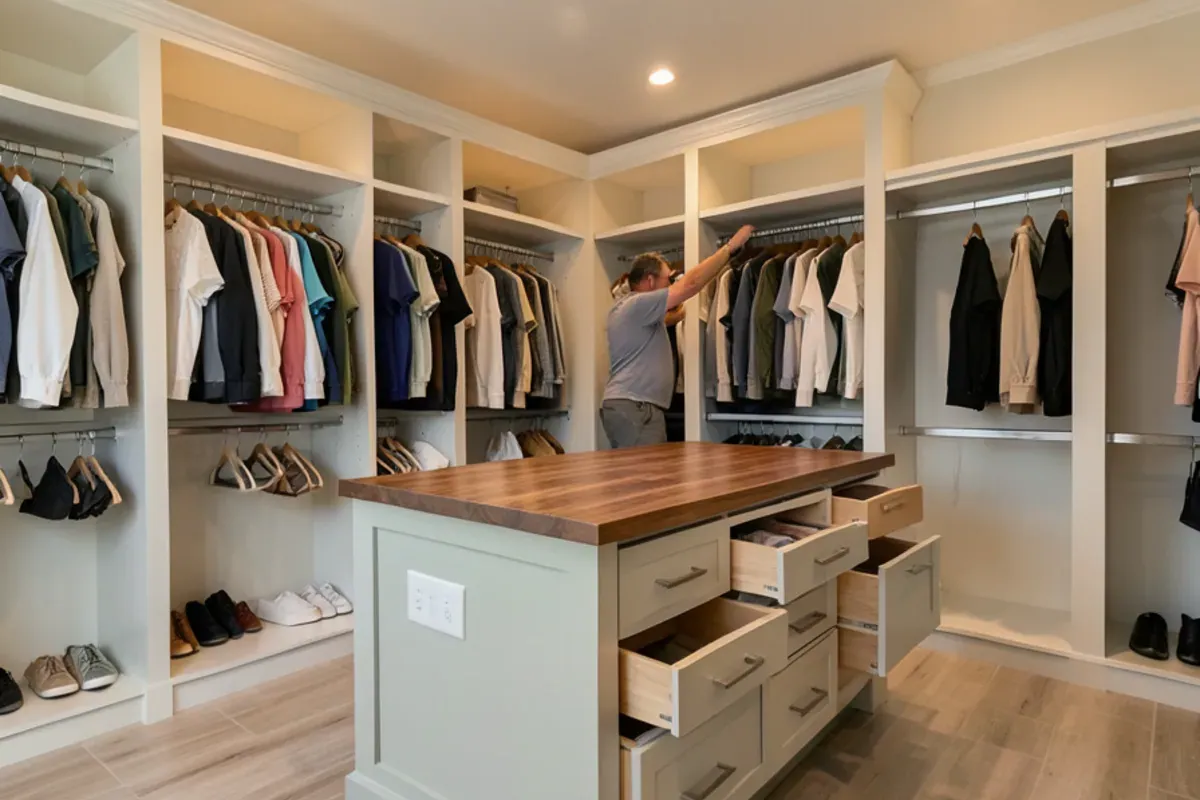
Newer homes in Lakewood Ranch often have generous walk-ins fitted with builder melamine. Owners there tend to keep the room and replace the system: drawers instead of bins, a closet island where the floor allows, and shoe shelves with a lip so pairs stay put. Our custom closets page shows the parts we build, and the wider family of custom built-ins covers bookcases, offices and laundry rooms done in the same way.
The bottom line
A closet that stays fresh in Florida is mostly about keeping humid air from settling: sealed panels, open paths for air and a finish on every surface. Sagging shelves or a stale smell in the wardrobe? Ring us, or send the closet's rough dimensions through the contact form, and we can talk through layouts before anyone visits.
Sources
- U.S. EPA — A Brief Guide to Mold, Moisture and Your Home
- U.S. EPA — Formaldehyde Emission Standards for Composite Wood Products
- USDA Forest Service, Forest Products Laboratory — Wood Handbook: Wood as an Engineering Material
- ENERGY STAR — Dehumidifiers
- USDA Forest Products Laboratory — Wood Handbook, Chapter 13: Drying and Control of Moisture Content and Dimensional Changes (Tables 13-1, 13-2)
- LCEC — Vacant Homes: A resource for operating your home efficiently while you are away